Variable Income Without the Anxiety: A Freelancer's Guide
Irregular paychecks don't have to mean irregular cash flow. With a smoothing strategy, a tax bucket, and a three-month buffer, freelance income becomes predictable in practice.
Freelance income is famously chaotic. One month you bill $9,000 across three projects. The next month two clients ghost their invoices and you bring in $2,400. The total over the year might be solid, but month-to-month it feels like financial weather.
The fix isn't more income. It's a structure that turns chaotic income into predictable spending. Three pieces: a smoothing strategy, a tax bucket, and a buffer. Each one is simple. Together they're transformative.
Piece 1: Smoothing
Smoothing means you don't pay yourself what you earned this month. You pay yourself a fixed monthly "salary" out of a holding account, regardless of what came in. The holding account absorbs the variance.
Pick a number that's roughly 70-80% of your average month over the last year. That's your salary. Every time a client pays you, the money goes into the holding account. Once a month, on a fixed day (the 28th works well, since it lands after most bills), you transfer your salary out. That's your "paycheck."
If your average is $7,000, set the salary at $5,500. The buffer in the holding account is what makes the system work. Underpaying yourself early lets you over-pay yourself later — bonuses, real vacations, equipment upgrades.
Piece 2: The tax bucket
The single most expensive freelance mistake is treating gross income as spendable income. That $9,000 month isn't $9,000 — it's roughly $6,300 after self-employment tax and federal/state. Spending the full $9,000 means borrowing from yourself, and the bill comes due in April.
Solution: a separate savings account. Every time a client payment lands, immediately transfer 25-30% to the tax account. Don't think about it. Don't optimize. Just transfer it. When quarterly estimates are due, the money is sitting there.
- Client pays $4,000 invoice.
- Same day: transfer $1,200 to the tax savings account (30%).
- Remaining $2,800 goes to the holding account.
- On the 28th, your fixed salary transfers from holding to checking.
- Quarterly: pay estimated taxes from the tax account.
30% is a common default for many freelancers in the US. If you're in a high state-tax state (CA, NY, OR), consider 32-35%. A small over-withhold is much better than the alternative. These figures are general information, not tax advice — confirm your rate with a tax professional.
Piece 3: The three-month buffer
Once smoothing and the tax bucket are in place, the next goal is to build the holding account up to roughly three months of "salary." If your monthly draw is $5,500, the target is $16,500 sitting in the holding account at all times.
This buffer is what lets the system survive a bad quarter. Two slow months with $1,800 of income each? The buffer absorbs it. You still pay yourself $5,500 on the 28th. Your checking account doesn't notice anything happened.
Building the buffer takes time — usually 6-12 months of disciplined under-paying yourself. But once it's there, freelance income stops feeling like freelance income. It feels like a salary.
How this looks in CalBudget
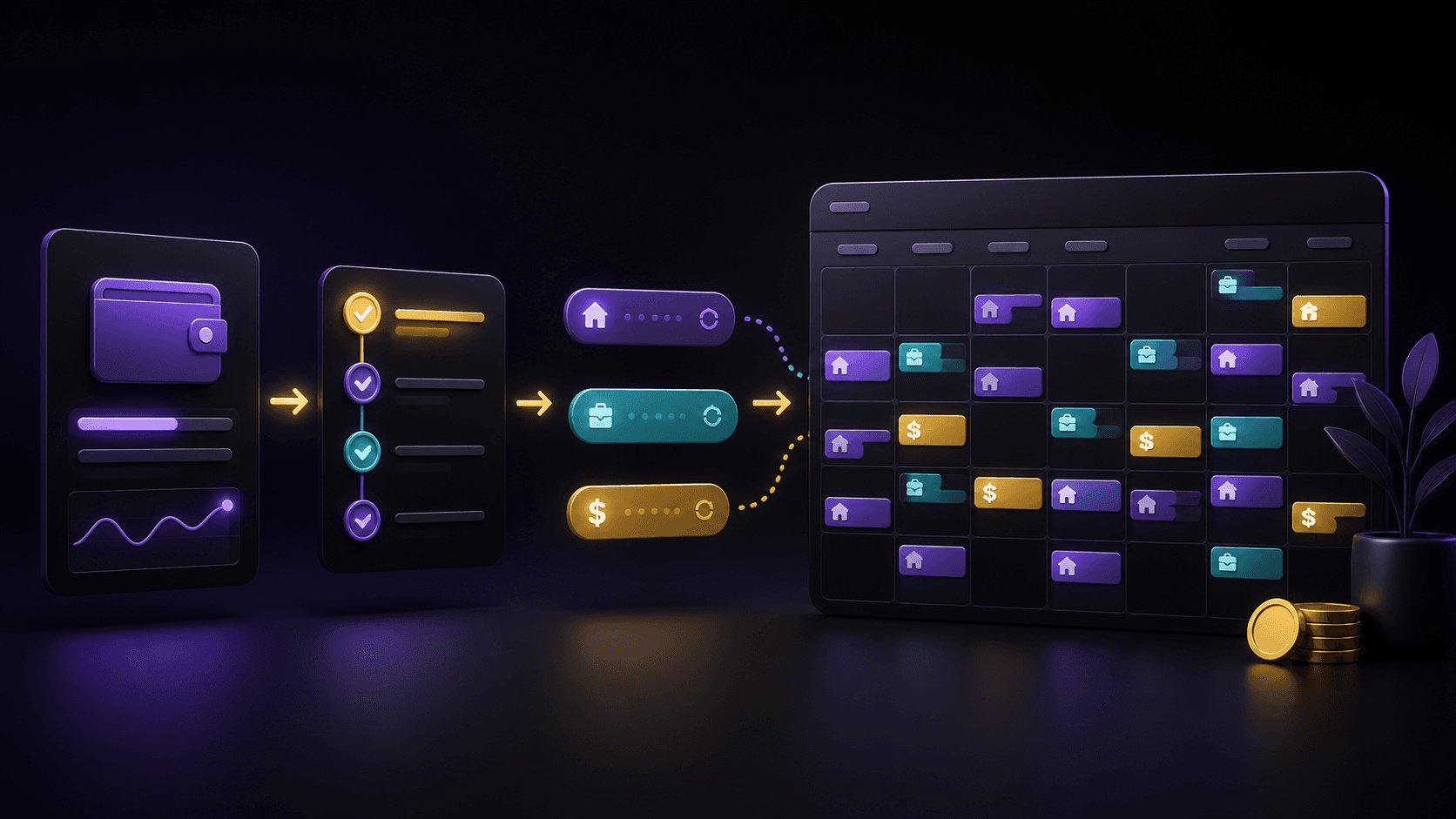
Set up three accounts: Checking, Holding, Tax. Each gets its own calendar and running balance.
- Checking: your monthly salary as a recurring transfer-in on the 28th. All bills and spending hit here.
- Holding: client payments hit here as expected income; the salary transfer hits here as a recurring outflow on the 28th.
- Tax: 30% of every client payment hits here; quarterly tax payments hit here as recurring outflows on Apr 15, Jun 15, Sep 15, Jan 15.
The result: your Checking calendar looks exactly like a salaried employee's. Predictable income on the 28th, predictable bills throughout the month. The Holding and Tax calendars carry the irregularity so Checking doesn't have to.
Running Balance: The One Number That Predicts Overdrafts
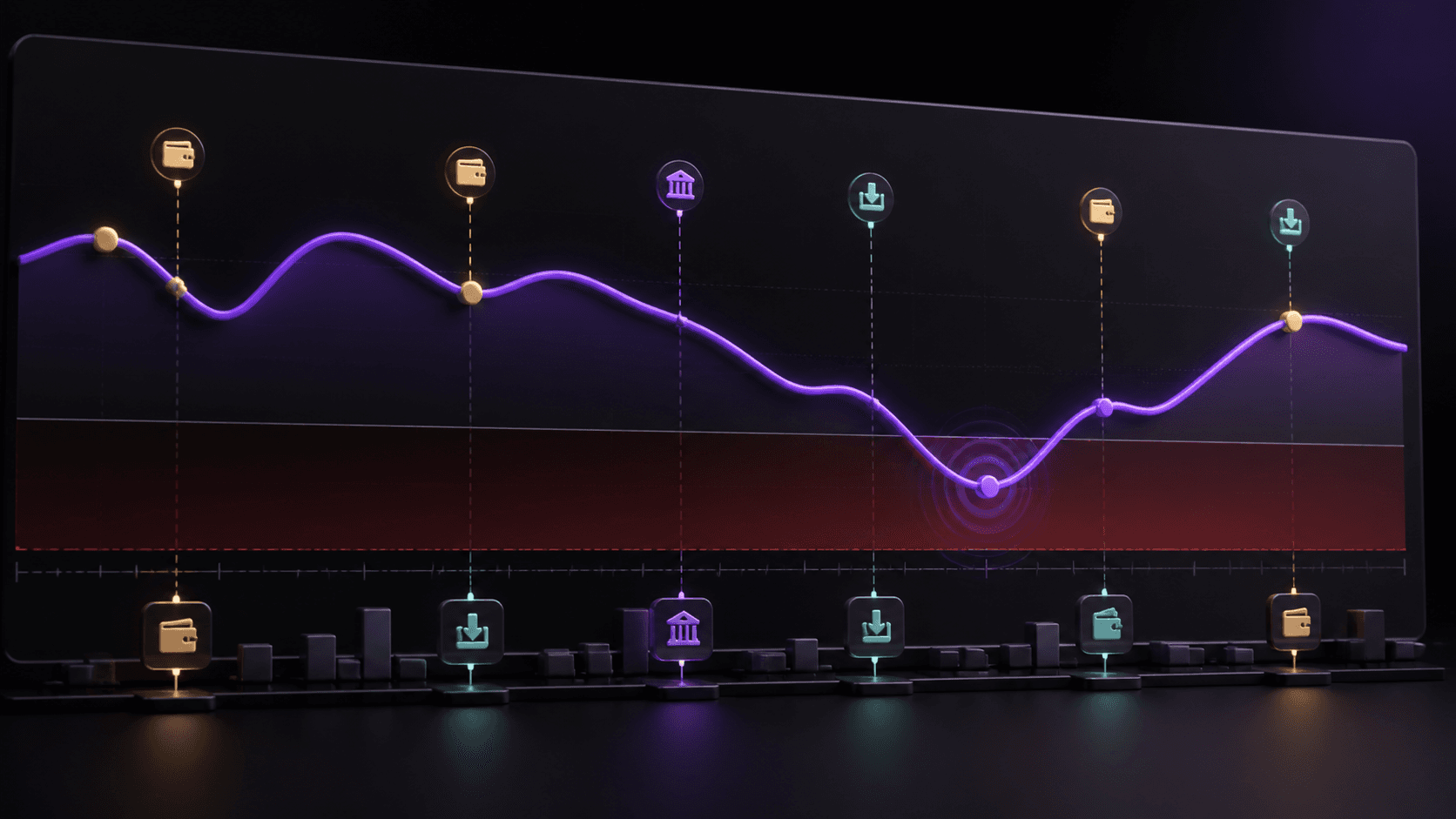
The smoothing system multiplies the value of a running balance — three accounts, three forecasts, all calmly visible at once.
Edge cases worth knowing
A few situations come up often enough to call out:
- Big project payment: don't raise your salary. Let the holding account grow. Pay yourself a one-time bonus once the buffer is fully funded.
- Slow quarter: don't lower your salary. That's what the buffer is for. If two slow quarters in a row drain it, then revisit.
- 1099 vs W-2 mix: same system. The W-2 paycheck just becomes a separate income stream on the calendar. The 1099 piece still flows through holding.
- International clients in foreign currency: enter the expected amount in your home currency at a conservative exchange rate. Update with actual when the wire lands.
Generic advice tells freelancers to save more. The smoothing/buffer/tax-bucket structure is more useful because it's mechanical. You don't need willpower — every client payment automatically routes itself, and you live off a salary that doesn't fluctuate.
Irregular Income Budget
How CalBudget handles unpredictable deposits: conservative income dates, a calendar of fixed bills, and a running balance that flags thin weeks.
The Quiet Cost of Subscriptions: Auditing Your Recurring Charges
Once your income side is structured, the next leverage point is your fixed monthly outflows. An annual subscription audit usually surfaces charges you forgot you were paying.
If you want to set this up, you can sign up at the homepage. Three accounts in CalBudget take about 90 seconds to create, and the smoothing structure starts working immediately.
Putting variable income budgeting into practice
Treat budgeting with variable income as a short weekly habit, not a one-time cleanup. Open the calendar, find your next two paychecks, then look at every bill, subscription, transfer, and planned purchase that clears before the second paycheck lands. That window is where most budget stress starts, because it is close enough to forecast accurately and far enough away that you can still change the outcome.
For freelancers, contractors, commission earners, and side-hustle households, the goal is not a perfect financial model. The goal is to know whether the next important date is safe. When the lowest projected balance looks uncomfortable, you have a clear menu of moves: shift a flexible due date, delay a nonessential purchase, split a large payment, transfer money earlier, or trim one week of the spending plan. A calendar budget puts those tradeoffs in front of you before the bank balance makes them urgent.
However you phrase the underlying question — freelancer budget calendar, or irregular income cash flow, or quarterly tax budget plan — it resolves the same way once the dates are on a calendar. Instead of one broad monthly total, you get a date-by-date answer: the day money arrives, the day it leaves, and the day that deserves your attention first.
The best variable income budgeting plan is the one you can check in under five minutes. Put the important dates on the calendar, watch the running balance, and let the lowest day tell you what needs attention next.
A 30-Day Action Plan for Variable Income Without the Anxiety: A Freelancer's Guide
Turn the advice in this guide into a 30-day experiment instead of a permanent rule you have to master immediately. During the first week, record the dates and amounts you already know: income, housing, utilities, debt minimums, subscriptions, transportation, groceries, and planned transfers. During the second week, compare those entries with what actually cleared. Correct the dates before changing the budget amounts. By the third week, the forecast should reflect your normal timing well enough to expose the one or two days that create the most pressure. Use the final week to make one repeatable adjustment and carry it into the next month.
This phased approach matters for variable income budgeting because an accurate baseline is more useful than an ambitious first draft. A bill that usually clears two days early, a grocery trip that moves with payday, or a transfer that is recorded as income can distort the entire picture. Correcting those details gives you a forecast you can trust. Once the timing is reliable, decisions about freelancer budget, irregular income budget, freelance cash flow become easier because each choice has a visible effect on the days that follow.
Measure Progress With Decisions, Not Perfection
A useful budget does not need every transaction to match the plan exactly. It needs to reveal a problem while the problem is still small. Track three signals: the lowest projected balance before the next paycheck, the number of expenses that arrived without a calendar entry, and the size of the difference between planned and actual flexible spending. Those measurements answer practical questions. Is the buffer growing? Are surprise transactions becoming less common? Is the forecast becoming more accurate from one week to the next? Progress in those areas is more durable than finishing one month with perfectly organized categories.
- Check the next two paychecks and every obligation scheduled between them.
- Compare the projected low point with a personal comfort floor, not merely zero dollars.
- Correct an inaccurate date as soon as a transaction clears earlier or later than expected.
- Make one adjustment at a time, then confirm that it improves the forecast before changing anything else.
Choose a comfort floor that reflects the way the account is used. Someone with a separate emergency fund may be comfortable with a smaller checking cushion. A household with variable income, automatic withdrawals, or frequent transportation costs may need more room. The number is not a moral score and it does not need to match anyone else's recommendation. It is simply the point where a normal surprise would force a transfer, a delayed bill, or an overdraft. Keeping the projected balance above that floor turns the calendar into an early-warning system rather than a record of what already happened.
Make the Plan Resilient to Real Life
Build a small amount of uncertainty into the forecast. Use the earliest reasonable date for withdrawals and the latest reasonable date for deposits. Round flexible expenses up when the exact amount is unknown. Add placeholders for irregular costs as soon as you learn about them, even if the estimate will change. This conservative approach may make the first forecast look less comfortable, but it prevents the plan from depending on every event going perfectly. When the real amount is lower or income arrives early, the difference becomes breathing room instead of money that was already promised elsewhere.
If the forecast still falls below the comfort floor, work outward from the low day. Review the seven days before it and separate fixed obligations from flexible choices. Protect housing, utilities, transportation, food, insurance, and required minimum payments first. Then test the smallest available move: reschedule an optional purchase, reduce one flexible amount, pause a transfer, or ask whether a provider offers a better due date. The objective is not to erase all spending. It is to solve the timing conflict with the least disruption and preserve a plan you can repeat next month.
At the end of the month, ask which single decision made variable income budgeting easier to follow. Keep that decision, remove any step that created work without improving the forecast, and use the updated dates as next month's starting point.
How to Set Up Your First Month in CalBudget
Connect this strategy to a dated running balance and make the next low-cash day visible before it arrives.
See CalBudget Features for Calendar-Based Planning
Review the calendar, recurring transaction, forecasting, and account tools used throughout this guide.
Frequently asked questions
How do I budget with irregular income?
Route every client payment into a holding account, then pay yourself a fixed monthly salary from it on a set day. The holding account absorbs the variance so your checking account sees a steady paycheck.
How much should freelancers set aside for taxes?
A common starting point is 25-30% of each payment into a separate tax account, more in high-tax states. This is general information, not tax advice — confirm your rate with a tax professional.
What is income smoothing for freelancers?
Income smoothing means paying yourself a fixed salary from a holding account instead of spending what you earned each month. Set it around 70-80% of your average month so the buffer grows.
How big should a freelance cash buffer be?
Aim for roughly three months of your monthly salary draw sitting in the holding account. That buffer lets you keep paying yourself the same amount through a slow quarter.